S.O.L.I.D. Principles Around You - DEV Community
#programming #software-development #object-oriented-design

In this article, I want to briefly go through SOLID principles (the acronym that stands for five basic principles of object-oriented programming and design) supplying each of them with real-world visual examples to make those principles more understandable, readable and memorizable.
If you want to see code examples instead you may take a look at variety of tree data structure implementations in JavaScript like Binary Search Tree, AVL Tree, Red-Black Tree, Segment Tree or Fenwick Tree.
So let’s move on!
S — Single Responsibility Principle
[a.k.a SRP] A class should have only a single responsibility. Only one potential change in the software’s specification should be able to affect the specification of the class.

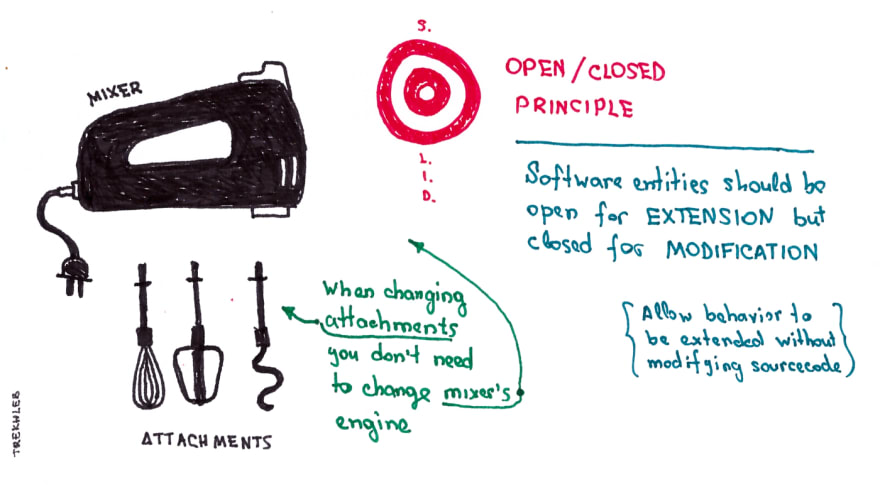
O — Open/Closed Principle
[a.k.a OCP] Software entities should be open for EXTENSION, but closed for MODIFICATION. Allow behavior to be extended without modifying the source code.
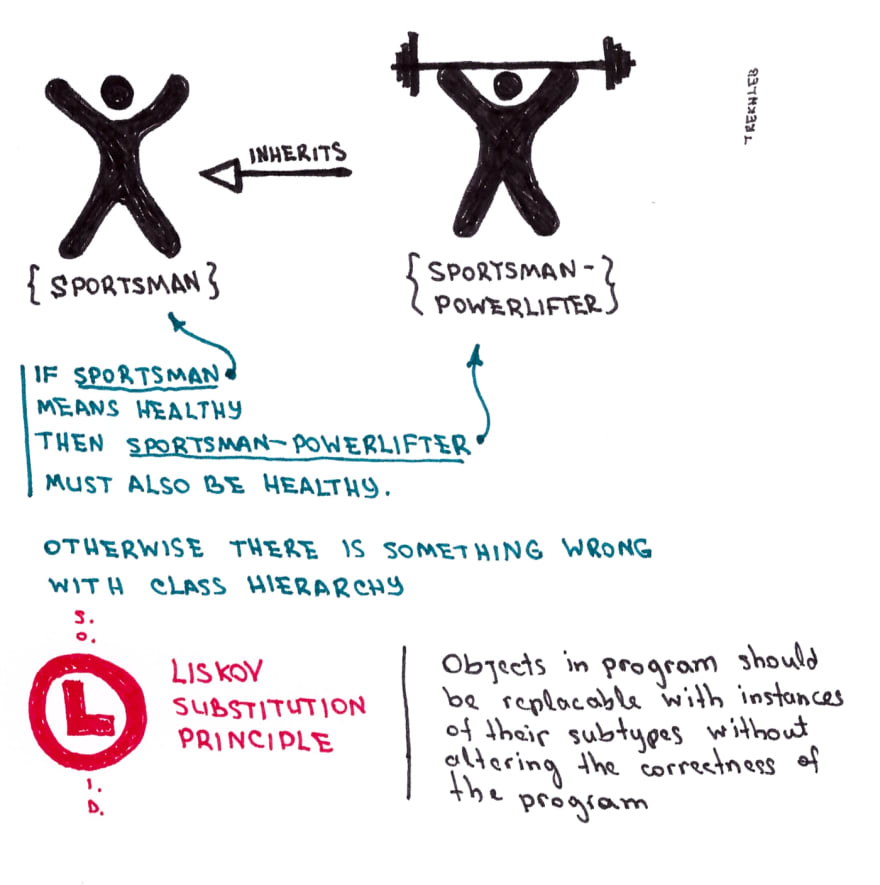
L — Liskov Substitution Principle
[a.k.a. LSP] Objects in a program should be replaceable with instances of their subtypes without altering the correctness of that program.
I — Interface Segregation Principle
[a.k.a. ISP] Many client-specific interfaces are better than one general-purpose interface. No client should be forced to depend on methods it does not use.

D — Dependency Inversion Principle
[a.k.a. DIP] One should depend upon abstractions, not concretions.
- High-level modules should not depend on low-level modules. Both should depend on abstractions.
- Abstractions should not depend on details. Details should depend on abstractions.
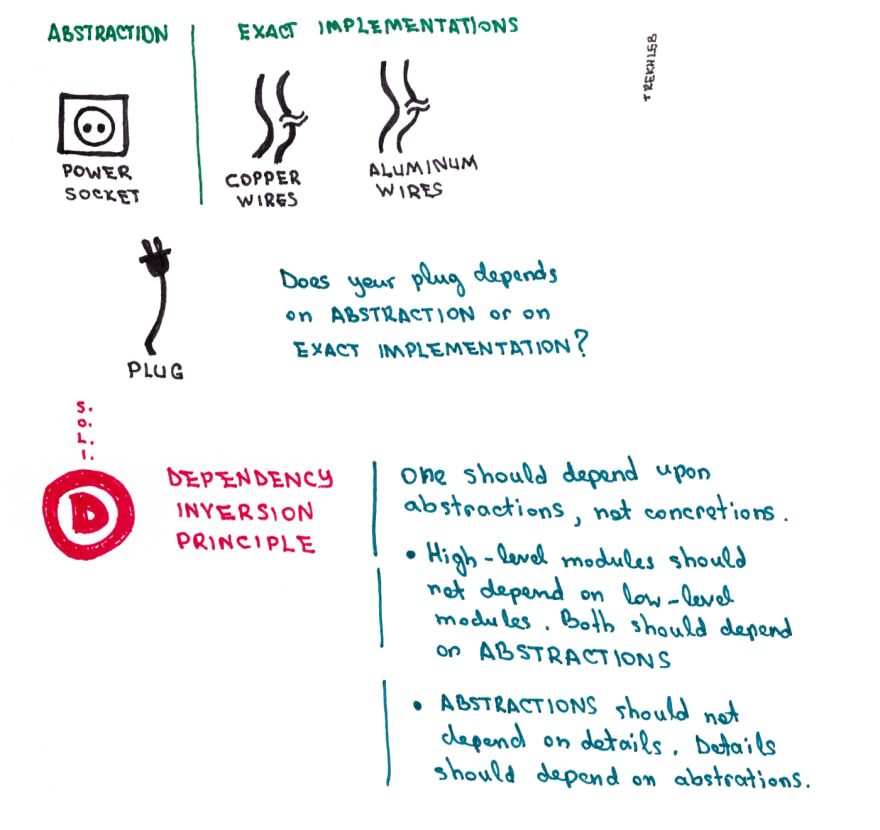
The plug doesn’t care which type of wire it uses, it just needs wires that conduct electricity.
I hope these illustrations have been useful for you :)